Plan My Comeback is paid by partner companies when readers use offers on this site. Advertiser Disclosure
A host planning dinner for 10 people on Thursday, November 26, 2026, has seen the headline: the American Farm Bureau Federation’s 2026 survey puts a classic Thanksgiving dinner at about $58.63, or roughly $5.86 a person. At the store, that number may not last. The 16-pound frozen turkey is a heavy line on the receipt, and beyond the survey’s rolls, cranberries, and pie fixings, the cart holds extra sides. By checkout, the total has passed $58.63. Why does the receipt disagree?
When the holiday dinner costs more than the headline
Get the free Plan My Comeback guides: practical, step-by-step help with debt, credit and budgeting, sent to your inbox after you answer a few quick questions. The guides are free, you can unsubscribe anytime, and answering the questions will not affect your credit score.
The gap is not a trick or a failure at checkout. The $58.63 figure comes from a fixed shopping list, priced in a particular way, and a real cart for 10 guests often includes more than that list. If the grocery total is already squeezing the rest of the month, you can also answer a few quick questions to get free Plan My Comeback guides on debt, credit and budgeting by email.
Why $58.63 is not the same as a receipt
The number comes from the American Farm Bureau Federation’s 41st annual Thanksgiving dinner cost survey. Volunteer shoppers in all 50 states and Puerto Rico checked prices in person and online the first week of November 2026, looking for the best possible prices but not using special promotional coupons or combined purchase deals (Farm Bureau). The classic menu, unchanged since 1986 so costs can be compared across years, is a 16-pound frozen turkey, cubed stuffing, sweet potatoes, dinner rolls, frozen peas, cranberries, a vegetable tray of carrots and celery, pumpkin pie mix, frozen pie crusts, whole milk, and whipping cream, in quantities for 10, plus miscellaneous ingredients to prepare the meal.
In that basket, the average cost is $58.63, up about 6 percent from 2025. It is the first overall increase since 2022, and still $5.42, or 8.5 percent, below the 2022 record of $64.05 (Farm Bureau; Farm Bureau Intel). Those figures describe the classic meal only. The expanded menu, which adds boneless ham, russet potatoes, and frozen green beans, averaged $81.72.
The same classic meal averaged $61.57 in the Northeast, the highest regional figure and about 5 percent above the national average, $58.74 in the West, $56.89 in the Midwest, and $54.33 in the South, the lowest (Farm Bureau Intel).
What is actually moving the bill
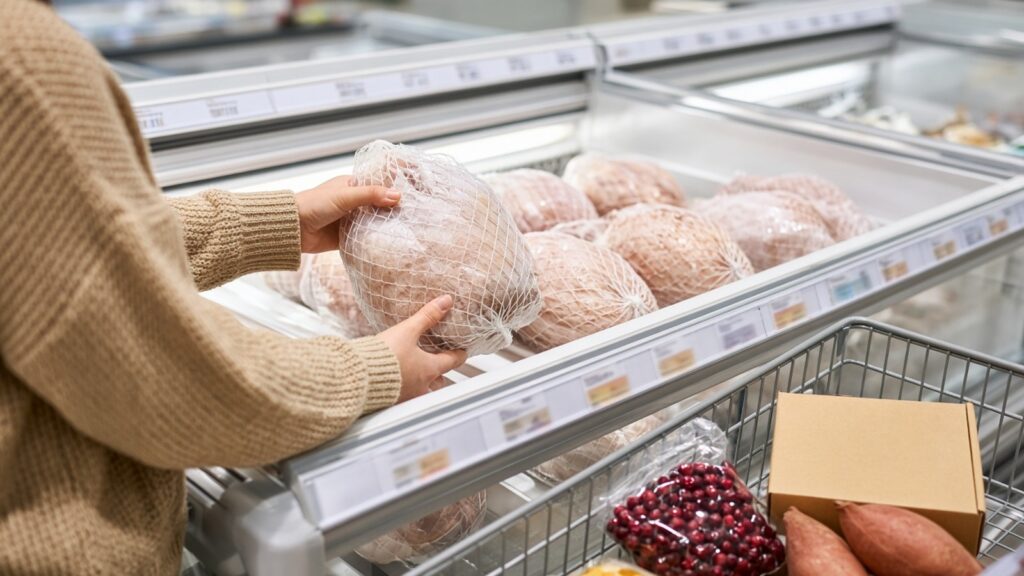
Turkey is doing most of the upward work. The survey’s 16-pound frozen bird averaged $23.68, or $1.48 a pound, up about 10 percent from 2025. Faith Parum, deputy chief economist for the Farm Bureau, called turkey the largest driver of the higher total and tied the increase to a recovering flock after years of disease pressure, with production still being built back up. The Farm Bureau also cited higher production costs (Farm Bureau Newsline; Farm Bureau).
Not every shopper will pay the average. Parum noted that grocery stores often promote turkey deals closer to the holiday, and Farm Bureau Intel said some volunteer shoppers found birds for as low as 69 cents a pound, nearly half the national average. Citing U.S. Department of Agriculture Agricultural Marketing Service data, the Farm Bureau said the average featured price for whole frozen turkeys declined during the second week of November 2026 (Farm Bureau Intel; Farm Bureau).
A third of the items in the classic survey declined in price: frozen pie crusts fell 9 cents, or 2.7 percent, to $3.28; a half pint of whipping cream was $1.84, down 1.6 percent; a one-pound vegetable tray of carrots and celery was $1.31, down 3.7 percent, the largest percentage drop; and frozen peas were $1.99, down 2 percent. Parum pointed to cheaper pie crust and whipped cream for anyone making pumpkin pie, even though a 30-ounce can of pumpkin pie mix rose slightly, to $4.24. Cranberries, milk, and dinner rolls rose more, to $2.48 for a 12-ounce bag (up 8.8 percent), $4.05 a gallon for whole milk (up 8.6 percent), and $3.81 for a dozen rolls (up 7 percent). Cubed stuffing and sweet potatoes rose as well (Farm Bureau; Farm Bureau Intel; Farm Bureau Newsline).
Parum also recommended store promotional books and coupon books, saying grocery stores want the Thanksgiving business and often offer deals in those circulars. Because the $58.63 average was built without those special coupons and combined purchase deals, a host who uses the circular may come in under the headline, while a host who skips the deals, shops in a higher-priced region, buys a fresh bird, or adds food the classic basket never counted may come in over it.
In the Consumer Price Index for October 2026, released November 10, 2026, the U.S. Bureau of Labor Statistics said the food-at-home index rose 0.4 percent from September, seasonally adjusted. BLS did not publish that index’s 12-month change for October 2026, because it did not collect October 2025 survey data during a lapse in appropriations (U.S. Bureau of Labor Statistics, Nov. 10, 2026).
If the cart has already passed the headline number
A holiday grocery total that runs past the survey figure can tighten the rest of the month. The free Plan My Comeback guides offer practical, step-by-step help with debt, credit and budgeting, sent to your inbox after you answer a few quick questions. They are free, you can unsubscribe anytime, and answering will not affect your credit score.
Keep the meal from following the household into January
On October 15, 2026, the National Retail Federation forecast November and December retail sales would grow 4.2 percent from 2025, to $1.013 trillion, and chief economist Mark Mathews said inflation, rising gas prices, and pressure on household spending would affect consumers differently across income groups (National Retail Federation, Oct. 15, 2026). If the gap between $58.63 and the real receipt, plus the rest of the week’s food and travel, lands on a credit card and stays there, the holiday can still be sitting on the January statement, with interest added on.
That is not a reason to skip the gathering or to stop any payment that is already due. It is a reason to treat the grocery total as part of the month’s budget, use the deals that lower the bill, and keep one dinner from becoming a balance that outlasts the leftovers. The receipt is the number that has to fit.
Plan the month so the holiday bill does not linger
One grocery trip is easier to fit when it is not left to a card balance in January. Answer a few quick questions to get free Plan My Comeback guides: practical, step-by-step help with debt, credit and budgeting, sent to your inbox. Free, with the option to unsubscribe anytime, and answering will not affect your credit score.
This article is for general information only and is not financial or legal advice.